
Hydrogen storage webinars.
From caverns to LOHC.
Storage is one of hydrogen's major technical bottlenecks. Solutions vary by scale, duration and use: compressed gas for mobility, liquid hydrogen for export, salt caverns for seasonal storage, LOHC for long-distance transport, hydrides for stationary uses. H2conf webinars break down these options with the operators and researchers deploying them.
Why attend a webinar on this topic?
Without efficient storage, no large-scale hydrogen industry. Yet each technology has its optimal regime: compressed gas excels in mobility but is volume-limited, salt caverns store at marginal cost but require specific geology, liquid hydrogen has an excellent energy ratio but consumes 30% of energy for liquefaction. A dedicated webinar gives you the key numbers to arbitrate based on your use case, and presents ongoing demonstration projects (HyPSTER in France, Hypos in Germany, etc.).
Topics typically covered
- 01Salt cavern storage: Hystock (NL), HyPSTER (FR), GWh capacities
- 02Cryogenic liquid hydrogen: -253°C, space and export applications
- 03LOHC (Liquid Organic Hydrogen Carriers): transport and logistics
- 04Metal hydrides: stationary low-pressure applications
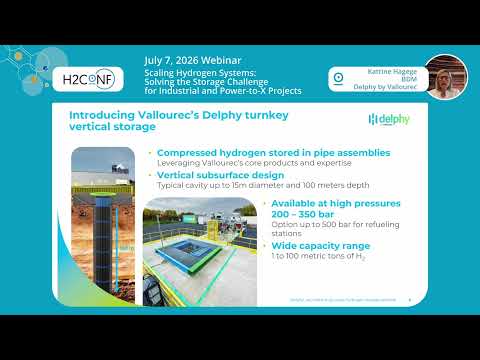
- 05High-pressure composite tanks 350 and 700 bar
- 06Storage economics: LCOS, OPEX, integration with LCOH
Who are these webinars for?
Webinars for energy storage engineers and project managers, gas distributor infrastructure teams, geologists and underground engineers, safety and HSE teams, industrial hydrogen hub developers, study teams for H₂ export projects, hydride materials researchers. Focus on regulatory constraints, full energy balances and feedback.
Upcoming webinars on this topic
No webinars scheduled right now. Browse the full agenda or subscribe to the newsletter.
Available replays on this topic
Frequently asked questions
Which underground storage projects are covered?+
Webinars cover the main European projects: HyPSTER (France, Salins-les-Bains), Hystock (Netherlands), Hypos (Germany), Underground Sun Storage (Austria), as well as US projects and Asian programs (Japan, Korea).
Is liquid hydrogen really industrially viable?+
Yes for specific use cases: long-distance export to Japan/Korea, space applications, some aeronautical projects. The energy cost of liquefaction (~30% of LHV) makes it non-competitive for routine stationary storage, but it remains the densest solution by volume after caverns.
What is the TRL of LOHC?+
Dibenzyltoluene-based LOHCs (Hydrogenious LOHC Technologies) are pre-commercial with operational pilot installations. TRL is 7-8 for transport, still 5-6 for direct mobility applications.
Explore other topics
Register for an H2conf webinar
Free or premium registration depending on the session. Become a member to access all replays, transcripts and PDFs.