Introduction
Hello everyone, I'm going to share my screen to talk to you today about white hydrogen. I'm Virginie Cartier, I'm a chemist by training, I worked 21 years in energy companies in France and the United States. Today, I'm an associate professor at UCLY, a university located in Lyon, with CSR — corporate social responsibility — as my specialty and expertise, and more specifically renewable energies including biogas and hydrogen.
Today I'm going to present and share some elements about white hydrogen, which I believe is an asset for France, for its ecological transition and for energy sovereignty, which is at the heart of current debates.
The National Hydrogen Strategy
The national hydrogen strategy was published in 2020 and updated in 2025. It relies on four levers :
— Environmental challenges, meaning the decarbonization of industry and transport
— Economic challenges, with hydrogen offering a real opportunity to create and consolidate an industrial sector and ecosystem that creates jobs
— The energy sovereignty challenge — reducing our dependence on hydrocarbon imports
— Technological independence, with the development of electrolyzers that can operate in different situations with different types of performance
Quantified Objectives
Total investment : €15 billion, with France 2030 funding of €6 billion.
PPE number 3 targets : 4.5 GW of electrolysis by 2030, 8 GW by 2035, and 20 TWh of decarbonized hydrogen by 2035.
In May 2022, the European Commission estimated the need for importing hydrogen in Europe at 10 million tonnes by 2030.
Key priorities for financing : hydrogen production projects, conversion of existing natural gas pipelines, development of new transport pipelines, and underground hydrogen storage.
The Different Types of Hydrogen
Global hydrogen production in 2024 was close to 100 million tonnes — 95% supplied by grey hydrogen, derived from hydrocarbon cracking.
The transition path leads toward :
— Blue hydrogen — hydrocarbon cracking with CO₂ capture
— Biomass hydrogen — feasible but relatively expensive
— Green hydrogen — water electrolysis using renewable electricity
— Pink hydrogen — water electrolysis using nuclear power
— White hydrogen — also called native or geological hydrogen, the heart of today's discussion
White Hydrogen : Sources and Mechanisms
Serpentinization
Water reacts with ferrous ions (Fe²⁺) to produce ferric ions (Fe³⁺) and hydrogen, under high pressure and temperature conditions near the mantle. The hydrogen released rises to the surface and accumulates under impermeable rock domes. This reaction produces hydrogen continuously, on a human timescale.
Natural Radiolysis of Water
Chemical decomposition of water into hydrogen under intense energetic radiation, also under high pressure and temperature conditions.
The Pioneering Story of Mali
1987 — 65 km north of Bamako, in Bourakébougou, a driller discovers explosive gas escaping from a well drilled in search of water.
2008 — Hydrocarbon exploration reveals the gas is 98% hydrogen.
2012 — Petroma (now Hydroma SA) installs a pilot electricity production unit.
2017–2022 — Major drilling and well-logging campaigns. Chromatography reveals several superimposed levels of hydrogen accumulation. 24 wells drilled, confirming the presence of hydrogen.
Prospects identified : transition to exploitation phase, electricity generation, and export to Europe as hydrogen or ammonia.
A Worldwide Distribution
According to Zgonnik (2020, Earth Science Reviews), hydrogen has been detected worldwide as free gas, diffusing gas, or dissolved gas. Natural hydrogen sources appear more evenly distributed across the Earth than hydrocarbon resources — a strategic advantage in a complex geopolitical context.
Exploration Projects in France
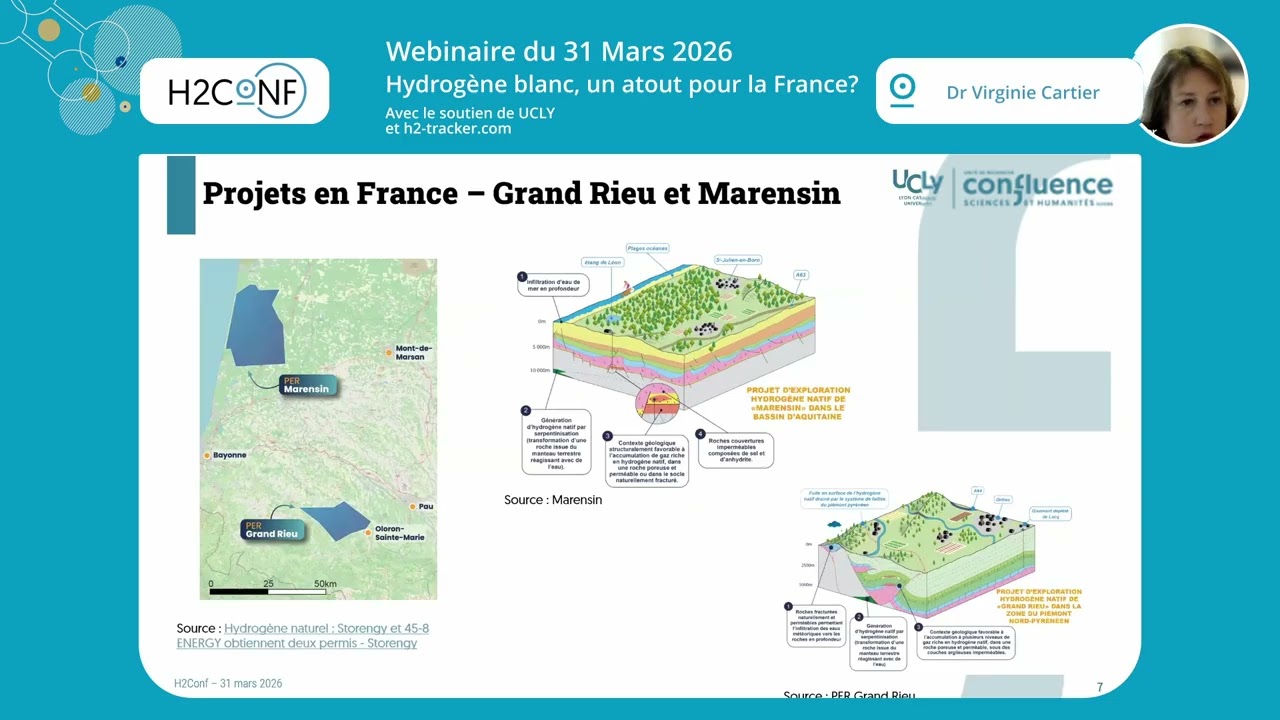
Grand-Rieux and Marencein (Southwest)
A consortium of Storengy and 45-8 Énergies obtained two exclusive research permits (PER) in southwestern France :
— Grand-Rieux, near Oloron-Sainte-Marie
— Marencein, above Bayonne, around Mont-de-Marsan
Teams are conducting gravimetric studies and passive seismic surveys to measure hydrogen potential and plan extraction.
The Régalor 2 Project in Moselle
Originally a collaboration between La Française de l'Énergie, the GéoRessources laboratory (CNRS), and the University of Lorraine — initially searching for methane (Régalor = "Gas and Lithium Resources in Lorraine").
2022 — Initial probe estimates native hydrogen concentration at ~15% at 1,100 meters depth. CNRS geologists estimate the deposit at 34 to 46 million tonnes of hydrogen.
November 2025 — Drilling begins at Folschviller (Moselle) on a 41-meter platform, targeting 4,000 meters depth. Recent publications confirm hydrogen presence — potentially the world's largest natural hydrogen reserve.
The Mosaïque pipeline between Germany and France, intended to transport hydrogen, is scheduled for commissioning by 2028.
Recommendations from the Academy of Technologies (2024)
Five major recommendations :
— Labeling natural hydrogen as decarbonized hydrogen to access public and European funding
— Simplification of exploration permit timelines (currently 18 months in France — the German model is faster)
— Financial support of a few million euros via BPI or France 2030
— Continued development of modeling tools specific to hydrogen exploration
— Supporting the sector to limit brain drain, and pursuing professionalization of operators in exploration, production, maintenance, and safety
Conclusion : Strengths and Challenges
Strengths
— Abundant and widely distributed reserves
— Favorable legislation with evolving mining law
— Estimated exploitation cost : $1/kg (Mali project) — significantly lower than grey hydrogen
— No CO₂ emissions during extraction and production
— Possibility of rapid development after discovery, building on existing hydrocarbon expertise
Remaining challenges
— Transition from exploration to production and transport infrastructure
— Cost of processing at sites — hydrogen's small molecule size requires specific, more expensive materials
— Social acceptability — essential to engage local communities proactively
Q&A Highlights
On the $1/kg cost — Does not yet account for compression, purification, hydration, or potential desulfurization. Further study needed, but comparable methods exist from natural gas compression.
On global reserves — Not fully mapped. Exploration is progressing; reserves were found where people looked. The 2020 map is likely already outdated.
On sustainability — White hydrogen is produced continuously under high-pressure conditions. Ongoing scientific research on serpentinization will improve understanding.
On comparison with green hydrogen — White hydrogen appears slightly less expensive than green hydrogen today, though this remains to be confirmed. Green hydrogen costs will decrease with economies of scale.