FCEV vs BEV: The Car of the Future — The Ultimate Showdown
Introduction
I am Eric Tranchand. After 25 years in the automotive industry, I now work at a local energy and climate agency focused on decarbonizing private collective housing. This presentation reflects my personal views and does not engage the agency.
Context: The End of Combustion Engines
In 2017, Nicolas Hulot, then Minister of Ecology, announced the end of combustion engine vehicles by 2040. The European Parliament has since moved that deadline to 2035, to combat climate change.
There are today two types of electric vehicles: fuel cell electric vehicles (FCEVs), powered by hydrogen, and battery electric vehicles (BEVs), powered by electricity. Both are relatively heavy and expensive. On the hydrogen side, only one mainstream option exists: the Toyota Mirai. On the battery side, the offer is much broader, with dozens of brands and price ranges.
The Match from the Driver's Perspective
Charging Time
Hydrogen refuels in 5 minutes at a station that looks just like a regular gas station. A BEV reaches 80% charge in 30 minutes at best. Winner: hydrogen.
Range
Our reference Tesla consumes 200 Wh/km with a 100 kWh battery, giving 500 km of range. The Toyota Mirai consumes 1 kg of H₂ per 100 km with a 5 kg tank, also giving 500 km. Draw.
Range in Hot Weather
According to the AAA, air conditioning reduces range by 33% for both vehicle types. Draw.
Range in Cold Weather
This is where the two technologies diverge sharply. The BEV suffers a 60% range reduction due to the heat pump. The FCEV, on the other hand, recovers the heat naturally produced by the fuel cell during operation — no range penalty whatsoever. Clear winner: hydrogen.
Purchase Price
The Toyota Mirai is expensive and few models exist. BEVs offer a much broader range with accessible price points. Winner: battery.
Running Costs
As a reference, diesel costs approximately €1 per 10 km (5 L/100 km at €2/L). Hydrogen at €10–15/kg with a consumption of 1 kg/100 km works out to roughly €1 per 7 to 10 km — close to diesel. A BEV charged at home at €0.20/kWh costs approximately €1 per 25 km, but on the motorway at over €0.50/kWh, the cost rivals diesel. Winner: battery, especially for home charging.
Charging Infrastructure
In 2019, France had 25,000 public BEV charging points versus only 20 hydrogen stations. Today, the BEV network exceeds 100,000 points, while hydrogen stations remain far behind the target of 1,000 by 2028. It is also impossible to refuel a FCEV at home. Winner: battery.
Driver Summary
Hydrogen is the clear choice if you live in a region with harsh winters, have a hydrogen station nearby, and need fast refueling. Battery wins if cost is the priority.
The Carbon Footprint
Transport accounts for 30% of greenhouse gas emissions in France. Decarbonization is unavoidable.
Manufacturing
Producing 1 kWh of battery capacity emits 100 to 150 kg of CO₂ — often in Asia using highly carbon-intensive electricity. A 100 kWh battery therefore emits 10 to 15 tonnes of CO₂ in manufacturing alone, equivalent to driving 125,000 to 187,000 km in a Toyota Prius hybrid (80 g CO₂/km). Since the FCEV battery is much smaller, the advantage is significant. Winner: hydrogen in manufacturing.
Operational Emissions — Well to Wheel
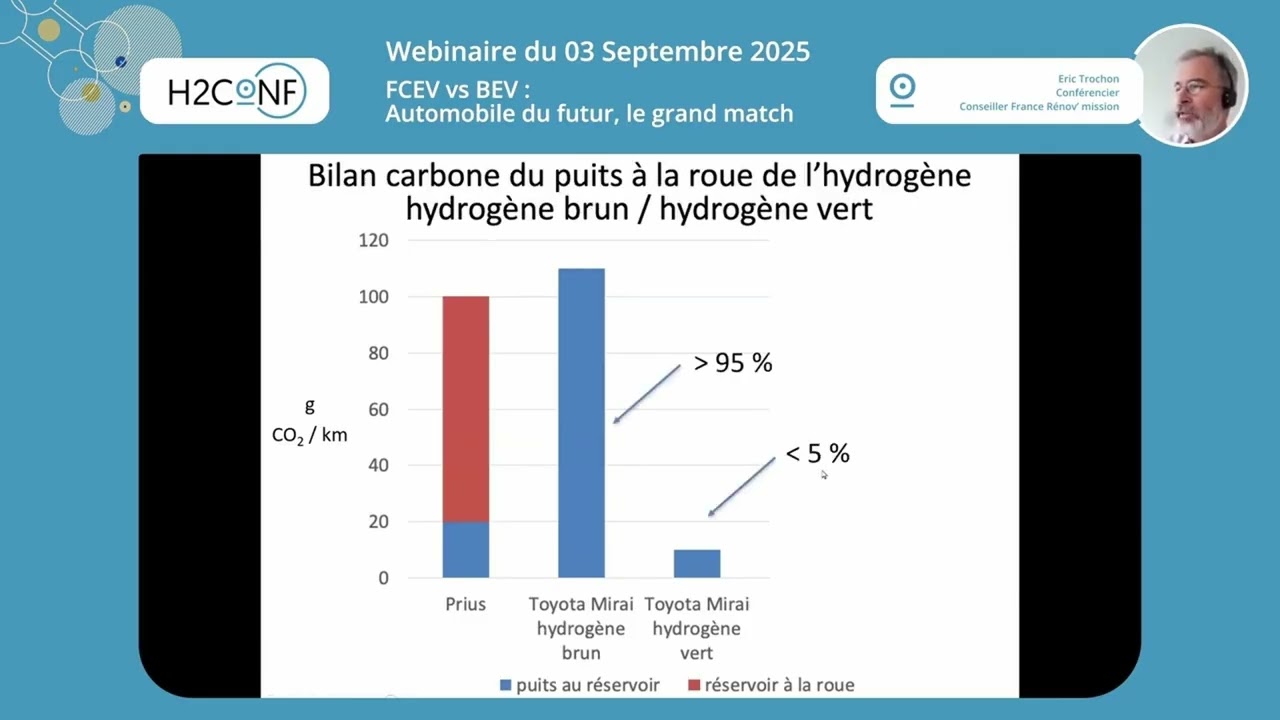
As a reference, the Toyota Prius emits 80 g CO₂/km at the exhaust, plus 20 g CO₂/km to produce and distribute the fuel — 100 g CO₂/km well to wheel.
The FCEV running on brown hydrogen — which represents 95% of today's hydrogen supply — also reaches approximately 100 g CO₂/km, since producing 1 kg of H₂ by steam methane reforming emits 10 kg of CO₂. Transport adds further emissions, requiring 20 times more trucks than a liquid fuel. With green hydrogen, emissions drop to near zero — but only 5% of hydrogen is green today.
The BEV with green electricity emits zero. In the real world, with a global electricity mix of 500 g CO₂/kWh and a consumption of 200 Wh/km, the result is approximately 100 g CO₂/km — the same as the Prius. In France, thanks to nuclear power (100 g CO₂/kWh), this drops to around 20 g CO₂/km.
Operational verdict: a draw in the real world, advantage BEV in France.
Impact on the Electricity Grid
Assumption for 2050: 40 million vehicles, 13,500 km/year each, 100% electric. France's current production: 500 TWh/year, installed capacity: 135 GW.
In Terms of Energy
A BEV consumes 200 Wh/km × 13,500 km = 2.7 MWh/year per vehicle, totaling 108 TWh for 40 million vehicles — about 20% of national production, equivalent to Belgium's entire consumption.
A FCEV consumes far more. Producing 1 kg of green H₂ requires 65 kWh. Its real consumption reaches 650 Wh/km, or 8.8 MWh/year per vehicle, totaling 352 TWh for 40 million vehicles — about 60% of national production.
This gap is explained by the poor efficiency of the hydrogen chain: electrolysis at 70%, compression and transport losses on top, and the fuel cell itself at 50% efficiency. According to ADEME, only 23% of the original electricity actually reaches the wheel, compared to around 80% for a BEV.
In Terms of Power
The FCEV refuels at a station with no impact whatsoever on the electricity grid. The BEV, however, draws 160 kW per vehicle during fast charging. If only 1% of the fleet charges simultaneously — which can happen during peak summer holiday migrations — that represents 64 GW of called power, nearly half of France's total installed capacity.
Grid verdict: advantage hydrogen for peak power, advantage battery for overall energy.
The Real Question: Can We Equip 40 Million Vehicles?
No — neither with batteries nor with hydrogen. Raw material constraints are real: lithium, cobalt and graphite for BEVs in exponentially growing volumes, and platinum for FCEVs — in limited quantities, though well recyclable.
The Solution: Frugality
Rather than equipping 40 million heavy vehicles, we need to fundamentally rethink mobility.
Cargo bikes first: one Tesla battery can power 250 of them, with a payload of up to 150 kg. And cycling for 30 minutes a day reduces the risk of all-cause illness by 30%, according to the WHO.
Slow electric quadricycles next — Citroën Ami, Renault Twizy, Fiat Topolino — with a range of around 200 km and very low consumption.
Trains, of course, which remain unbeatable in energy efficiency. A hydrogen aircraft would consume 10 times more energy.
Hydrogen buses, already around 50 in France with over 200 in deployment — a relevant solution for long-distance routes without electrification.
And finally VELIs or VEPHs — Light Electric Intermediate Vehicles or Human-Powered Electric Vehicles. Their weight is divided by 20, their consumption by 10 compared to the most efficient BEV. Supported by ADEME through the Extreme Défi program, they remain economically fragile without public backing, as illustrated by the bankruptcy of the German Biohybrid vehicle.
The Mobility Mix for 2050
A few FCEVs for taxis, ambulances, utility vehicles and car-sharing. A few BEVs for larger vehicles. Hydrogen buses for intercity transport. Slow electric quadricycles. VELIs and VEPHs. Cargo bikes. And above all, trains.
Q&A
On fast charging — Most users charge at home. Heavy users plan their charging stops along the route, with approximately 50% of charges done outside the home for intensive use cases.
On VELIs — They need public support to take off. Reducing speed limits in towns and on rural roads is an essential condition for their safety and development.
On biofuels — Global bioethanol production could never cover the needs of a worldwide fleet of approximately 1 billion vehicles without directly competing with food production.
On pink hydrogen — Hydrogen produced by electrolysis using nuclear electricity is technically called pink hydrogen, distinct from green hydrogen derived from renewable sources.